
Values in an Arlington County Property Record
An assessment record from Arlington County's DREA carries several distinct figures. It shows the annual assessed total. It also splits value between land and building components. Assessment history and recent sales appear too. A deed is different evidence entirely: it documents a transfer and may include consideration. The assessed value drives taxation, while a market estimate or a recorded sale answers a different question about the same parcel.
| Value | What It Is | Where |
|---|---|---|
| Assessed value | Annual county value for taxation, tied to an assessment year | DREA parcel card and notice |
| Land component | Portion of the assessment assigned to land | DREA assessment record |
| Building component | Portion assigned to improvements on the parcel | DREA assessment record |
| Recent sale history | Transactions considered in assessment context | DREA parcel record |
| Recorded transfer | Legal conveyance and land description, with instrument details | Arlington Cloud Search |
Assessment and sale price rarely match. Dates, purposes, and evidence all differ. DREA's annual method rests on a county sales study, while the deed is simply the instrument that records a transfer. The county publishes no single assessment ratio for every parcel, so resist the urge to compute one from a generic formula.
Find an Arlington County Assessed Value
DREA's Property Data Search accepts three entry points. Type a physical street address, an owner or business name, or an eight-digit RPC. Each assessed value ties to one parcel. Record both before comparing numbers. The assessment notice tab pulls a notice by year, and the county methodology page explains how land and improvements are treated.
- Search DREA by situs address or RPC and confirm the parcel's legal description.
- Read the assessed amount, assessment year, and land/building components shown for that record.
- Review recent sales history as assessment context and keep the transaction date visible.
- Use Cloud Search to inspect the recorded transfer when a deed or sale reference matters.
- Assessed value
- The county's annual figure used for real-estate taxation.
- Market value
- An estimate of what a property may sell for under market conditions.
- Sale price
- The amount tied to a completed transaction; it is not automatically the current value.
- Mass appraisal
- A valuation method applied across many properties, rather than an inspection for one sale.
What Arlington County Assessed Value Does Not Mean
A DREA assessed value serves one purpose: taxation. It is not a listing price. It is not a sale prediction or the appraisal a lender orders for a transaction. Gaps from the recorded price are normal. The assessment is annual and rests on a defined study period, so a sale-specific appraisal requires a qualified appraiser and a separate scope of work.
Assessment versus price. An Arlington County assessed value is for the tax roll. It does not establish what a buyer will pay or replace an appraisal.
Arlington County Annual Property Value
DREA builds a fresh assessment every year. Each value is set for the January 1 tax year. For single-family homes, the method uses sales from September 1 through August 31. Those sales come from before that assessment. A sale after the study window can lag behind. It may miss that year's figure entirely. The result is a county value tied to one cycle, not a live market quote.
The Arlington County assessment methodology page describes the annual study. It also explains the allocation between land and buildings. Check a value's notice year. Reading an Arlington County property value without that check makes a prior assessment easy to mistake for the latest one.
Arlington County Condominium Values
Arlington County handles condominiums with unusual care. DREA treats each condominium project as its own neighborhood for assessment. Living area, baths, floor height, views, and parking all count. Units in one building can differ in ways that move their assessed values. Compare similar units.
Look up the unit and its RPC. A building's street address alone is not specific enough. The land and building component on the card adds detail, and a recent sale adds context, but neither turns the county's mass appraisal into a unit-specific market appraisal.
Arlington County Sales Study Window
The county's sales study has firm edges. It runs from September 1 through August 31 before the January 1 assessment year. DREA folds recent transactions into its annual work. The parcel record may also carry recent sales history. The window explains how the assessed number took shape, but it does not make every sale a comparable or push a later transfer onto the current roll at once.
Read dates with care. Pair the sale date with the assessment year and the parcel type. Arlington's condominium method groups projects separately, and DREA weighs features like views and parking. One sale never prices a neighborhood.
Arlington County Sale Price and Deed
Two documents, two jobs. DREA's recent sales history supports county valuation. Cloud Search is the index for the recorded conveyance itself. A deed may include consideration. If it does, read the instrument and confirm the legal description. Deeds do not follow one uniform layout, so the visible fields can differ from one recording to the next.
A sale price reports a transaction. It is not automatically the property's current market value. Weigh the transaction date, property condition, unit features, and assessment year before drawing any value conclusion. For tax bills and appeal procedures, the Arlington County tax record page covers those separate topics.
Compare Arlington County Property Values
Arlington County GIS includes an REA Neighborhoods layer that draws assessment-neighborhood polygons. It is useful geographic context. It is not a subdivision plat, though, and it promises nothing about market value. When comparing parcels, keep the assessment year and property type the same. With condominiums, a project's own traits can matter more than the street outside.
The DREA assessment card often lists zoning, lot size, classification, map-book page, and assessment history. It also lists recent sales. Those fields help build a fair comparison set. Remember that the GIS parcel map is reference geometry only. It cannot settle a boundary dispute or set the value of a home.
Arlington County 2026 Value Review
Arlington has published its 2026 assessment notice insert and refreshed the online appeal page. The dates and submission options sit with the tax appeal process, while the property value page explains what an assessment actually represents. If a 2026 number looks wrong, keep the notice year and parcel details together. Then confirm the current review path on the county page.
The image points to the county's assessment review applications. That page shows the review channel itself, not any parcel's value.
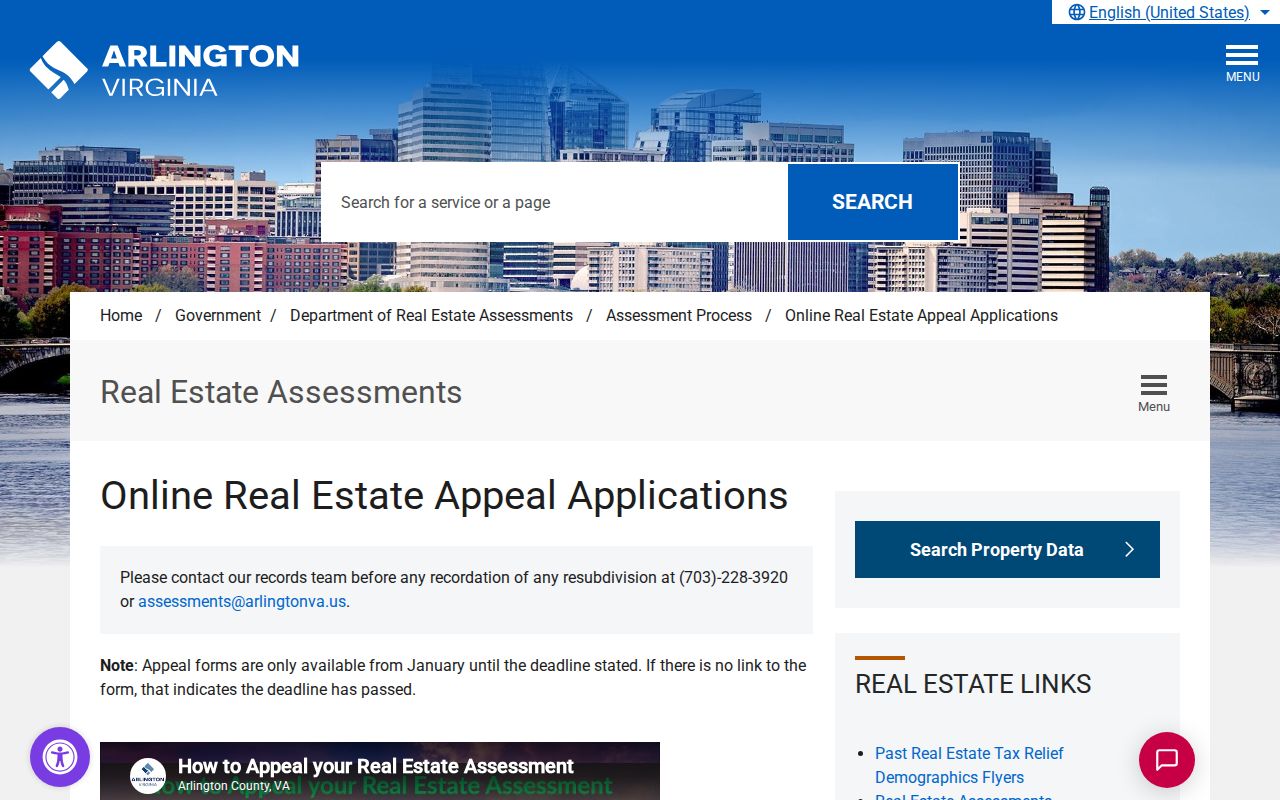
For filing dates and accepted methods, follow the live county appeal instructions along with the parcel's assessment notice.
Arlington County Property Value Fields
The county's documented assessment inventory covers a lot of ground. It records the current owner, the RPC, mailing and situs addresses, zoning classification, lot size, legal description, property classification, map-book page, assessment history, and recent sales. Field labels and their order on the live property search screen may differ from the county guide. So check both.
Always pair an Arlington County property value with its assessment year. Using the number for a tax appeal means checking the appeal page. Using it for a sale decision calls for a separate appraisal. A market analysis from a qualified professional works too.