
Find Who Owns an Arlington County Property
The surest public-record path runs from the street address to the newest deed. DREA's Property Data Search links an address, owner or business name, or RPC to an assessment record. That card carries the owner-of-record field, a separate mailing address, and the legal description. Treat the eight-digit RPC as a bridge. It connects the assessment record to the GIS parcel. From there, compare the parties and land description on the latest deed. The county record speaks clearly this way. It still is not a full title search.
- Search the address in DREA and copy the owner name, RPC, situs, and legal description.
- Match the RPC to the Arlington GIS parcel so the right lot is under review.
- Search the named party in Cloud Search as a possible grantee and inspect the latest matching deed.
- If an entity is named, check its Virginia SCC filing and registered-agent details without assuming the agent owns the parcel.
- Use the mailing address only for appropriate property correspondence; it does not prove where anyone lives.
Arlington County Property Owner Sources
Several Arlington County records can name an owner. Each was built for a different job. DREA keeps the annual administrative owner-of-record field. Cloud Search indexes the party named on a recorded deed. GIS adds parcel geometry and the RPCMSTR layer. It makes no independent title decision. SCC CIS can identify a business entity tied to an owner name. An owner lookup works best when the address, RPC, and deed description all line up.
| Source | Owner Info It Gives | Access |
|---|---|---|
| DREA assessment record | Owner-of-record name, RPC, situs, mailing address, and legal description | Public Property Data Search |
| Cloud Search deed index | Grantee and grantor names in recorded instruments | Free basic index after registration; images cost extra |
| Virginia SCC CIS | Entity status, filing history, principal office, and registered agent where shown | Public business-information system |
| Arlington GIS | RPCMSTR label and mapped parcel geometry | Public parcel service |
An owner of record is not always the occupant. DREA keeps a mailing address apart from the physical situs, and notices may go elsewhere. Treat that mailing address as a correspondence clue. It proves no one lives anywhere.
Limits of an Arlington County Owner Lookup
A public search can name the party on the assessment roll or recorded deed. It cannot confirm occupancy. It cannot prove every legal claim has surfaced. The owner field reflects an annual roll, so a recent closing may not appear yet. Virginia also enforces protected-address and confidentiality rules. Use Arlington County public property records for property research, title diligence, and civic purposes. They are not a tool for targeting a person.
Lawful use. Use Arlington County ownership records for legitimate property research. Do not use an owner name or mailing address to stalk, harass, threaten, or harm anyone.
Arlington County RPC Ownership Match
The eight-digit RPC anchors an ownership search to one parcel. Write it down before moving between DREA, GIS, and Cloud Search. Arlington's parcel label layer stores RPCMSTR as eight-character text. Older deeds may lean on a legal description instead of a street address. Matching the RPC against the situs and land description cuts the risk of mixing up two nearby properties. It also helps separate two owners who share a name.
The property card adds useful context. Map-book page, lot size, zoning, property type, assessment history, and recent sales all help confirm the right parcel. None of that proves the deed's legal effect. When a resubdivision or lot adjustment is in play, pull the recorded plat. Then compare the current assessment record after the change.
Arlington County Owner-of-Record Timing
DREA's owner field belongs to the annual assessment roll. The county names no fixed lag between a closing and a roll update. So a new buyer should not expect same-day results. The assessment card will not change the day a deed is recorded. Cloud Search is the better stop for a just-filed conveyance. Then revisit DREA as the county refreshes its assessment data.
The current owner field suits a first look and parcel-to-deed matching. It is an administrative value. It is not a warranty about title. Suppose DREA lists a prior owner while the deed names a newer grantee. Keep the dates and references at hand. Bring them when asking the office about the parcel.
Confirm an Arlington County Owner by Deed
For a recent transfer, the latest recorded deed beats everything else. Search the named owner as grantee in Arlington Cloud Search. Then inspect the instrument's grantor, grantee, recording reference, and land description. The live index field labels vary. Check the document image itself rather than trusting a guessed layout.
Basic index information is free once you create a user account. Remote images cost a per-page charge plus a transaction fee. Courthouse kiosks, ScanPro, microfilm, and mail copies offer other routes in. Copy rules belong to the deed record process. For this owner question, match the instrument to the same RPC. The legal description must line up too.
The full copy and chain process is on the Arlington County deed records page.
Arlington County Trust and LLC Owners
A parcel may sit in the name of an LLC, trust, estate, or other entity. It may also be held rather than by a person. DREA supports owner and business-name search. But its public guidance promises no single standardized display for every vesting type. Read the deed for the entity name and its capacity. For a Virginia corporation or LLC, the Virginia SCC Clerk's Information System can reveal entity status. It can also show the SCC ID, registered agent, principal office, and filing history.
That system serves entity searches, not parcel-owner rosters. A registered agent accepts service for an entity. The agent is not necessarily a member, manager, beneficiary, or anyone who occupies the property.
Treat the deed as the proof of who took title. The state entity record only explains what kind of organization that grantee is.
Arlington County Property Alert
Cloud Search users can define criteria for Property Alert. A notice arrives whenever a matching document hits the record. Treat it as a watchdog. It works best after an owner or parcel number has already been pinned down. An alert flags a match and nothing more. It cannot judge whether a filing is valid or fraudulent. Reading the recorded instrument itself still beats acting on the notice alone.
The county's Land Records page lays out the alert route Arlington County offers. When an alert points to a filing, open the index result. Check the parties and the legal description before doing anything with it.
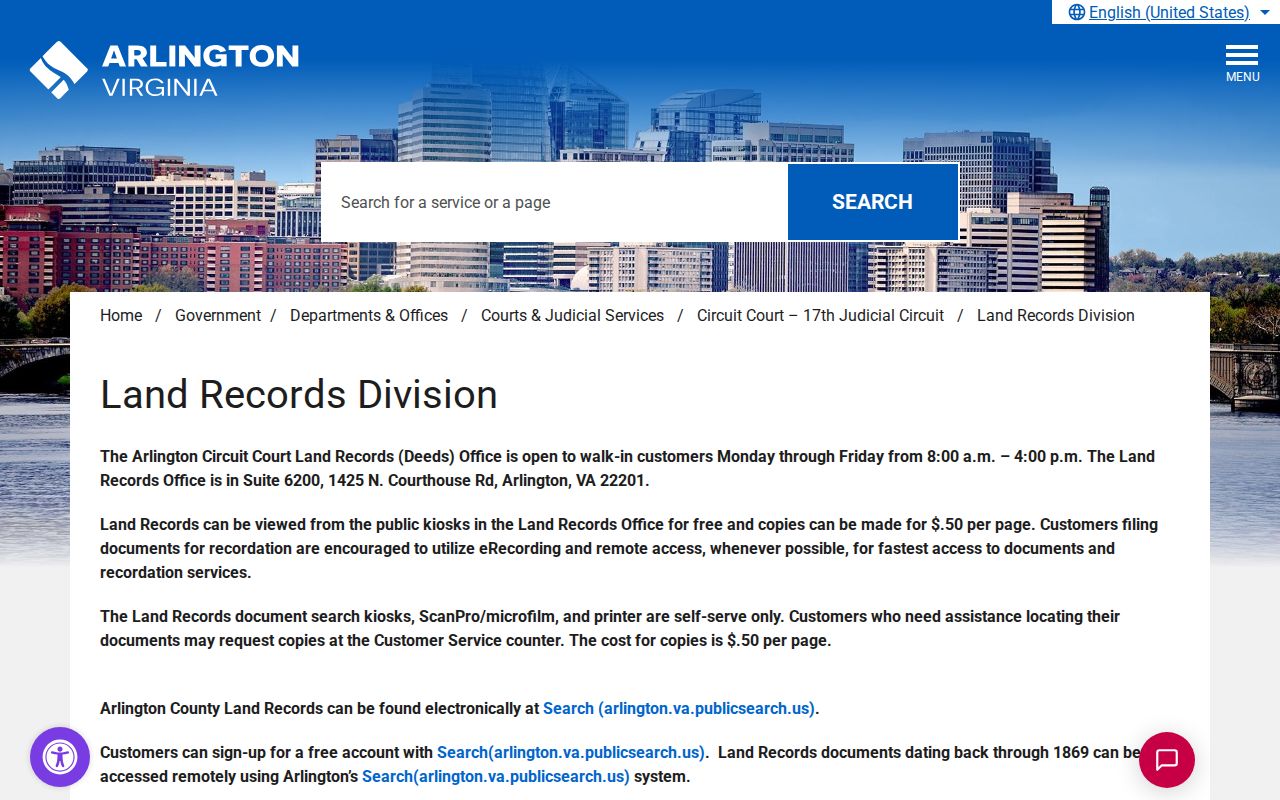
A Property Alert is only a match notice. For an official determination on any filing, contact Land Records.
Arlington County Mailing and Situs Addresses
A situs address is where the parcel sits. A mailing address is where the tax bill and assessment notices go. Arlington County accepts written requests to change a mailing address. That is why the two fields must stay distinct. Never assume the mailing address is the owner's home. A name on a parcel card does not confirm an occupant either.
Any property-related contact through the mailing field should stay lawful and relevant to the parcel. Some addresses fall under state confidentiality programs for sensitive situations. Access to public records does not license publishing private details. Nor does it license using them to harass anyone.
Arlington County Owner Search Boundaries
Arlington's Circuit Court Land Records Division records real property for Falls Church too. But pre-1988 Falls Church deeds live with Fairfax Circuit Court. A deed that seems missing may simply sit across the jurisdiction line. It is not a missing owner. Before deciding the chain of title dead-ends at Arlington's portal, check the situs and the transfer date.
An Arlington postal address proves nothing about which county holds the parcel. Confirm jurisdiction with the county GIS map, the RPC, and the legal description. An older transfer may belong to Fairfax. In that case, search the custodian that held the deed at the time.